
How is injury time calculated? Why matches are getting longer than ever
Injury time is no longer unusual in modern football, as almost every match now includes at least one or two minutes of added time. In fact, over the last few years, injury time has become increasingly common, with some matches reaching 10 or even 11 minutes of additional play. goaloomobi.com answers the question: How is injury time calculated?
How is injury time calculated?
The calculation of injury time is the responsibility of the refereeing team, with the main referee having the final decision regarding the exact amount of added time. As each half approaches its end, the referee communicates the minimum amount of additional time to the fourth official. The fourth official then displays the number on an electronic board so that players, coaches, and spectators are informed.
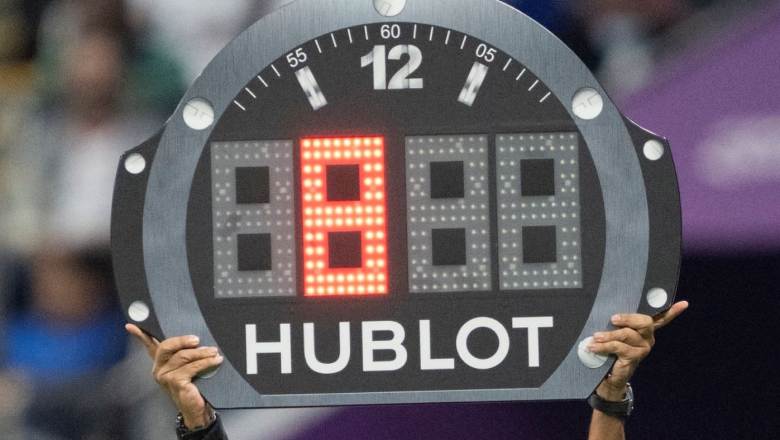
According to the rules established by International Football Association Board (IFAB), referees add time at the end of each half based on several specific situations.
- Substitutions: Each substitution is generally estimated to consume around 30 seconds.
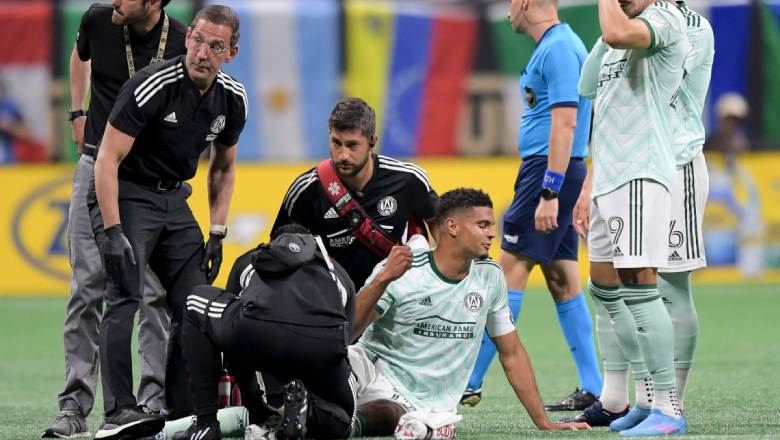
- Treatment of injured players: The time required for medical staff to enter the field, assess injuries, and help players leave the pitch is included in added time.
- Time-wasting: Referees also compensate for deliberate delays, such as players taking excessive time over throw-ins, goal kicks, free kicks, or restarts.
- Disciplinary incidents: The time needed for referees to issue yellow cards, red cards, or manage disputes between players is also counted.
- VAR reviews: This is one of the biggest contributors to modern injury time. Referees may spend several minutes communicating with video officials or reviewing incidents on pitch-side monitors.
- Goal celebrations: Celebrations after goals can often last between one and two minutes, especially in important matches. Referees record this lost time and add it back at the end of the half.
When did injury time originate?
The origin of injury time dates back to 1891 during an English football match between Aston Villa and Stoke City. Aston Villa were leading 1-0 when Stoke City received a penalty with only a few minutes remaining.
To waste time and prevent the penalty from being taken quickly, the Aston Villa goalkeeper deliberately kicked the ball far away from the field. At that time, the rules stated that matches had to end immediately after 90 minutes with no exceptions. By the time the ball was returned, the match had reached full time and the referee blew the final whistle, meaning Stoke City lost their opportunity to take the penalty.
The incident caused major controversy, leading the English Football Association to amend the rules in 1892. Referees were officially allowed to add time at the end of each half to compensate for stoppages caused by injuries, substitutions, and deliberate delays.
How has injury time changed over time?
After more than a century, injury time has evolved significantly. During the 1994 FIFA World Cup, FIFA introduced the use of electronic boards held by the fourth official to display added time publicly. This increased transparency and reduced arguments surrounding referees’ decisions.
The next major change arrived in 2018 with the introduction of VAR technology. Video reviews could sometimes last between two and five minutes, forcing referees to calculate stoppages more accurately rather than relying on rough estimates.
At the 2022 FIFA World Cup, the approach to injury time changed again. Referees were instructed to add time for almost every interruption, including long celebrations, slow restarts, injury treatments, and substitutions. As a result, several matches featured total added time exceeding 15 or even 20 minutes.
FIFA’s objective was to increase the amount of “effective playing time” in matches, aiming for around 60 minutes of actual football action per game. Following the tournament, major leagues such as the Premier League officially adopted stricter injury-time calculations from the 2023/24 season onward. Matches regularly began exceeding 100 minutes in total duration.
Matches with the most added time in football history
1. Shabab Khanyounis vs Ittihad Khanyounis (2019)
One of the strangest incidents in football history occurred when the stadium floodlights failed during a match between Shabab Khanyounis and Ittihad Khanyounis. The referee suspended the game for approximately 42 minutes while technicians repaired the lighting system.
After the lights returned, the match resumed and the entire delay was effectively added to the total match time. This is considered one of the longest periods of added time ever recorded in modern football.
2. England vs Iran (World Cup 2022)
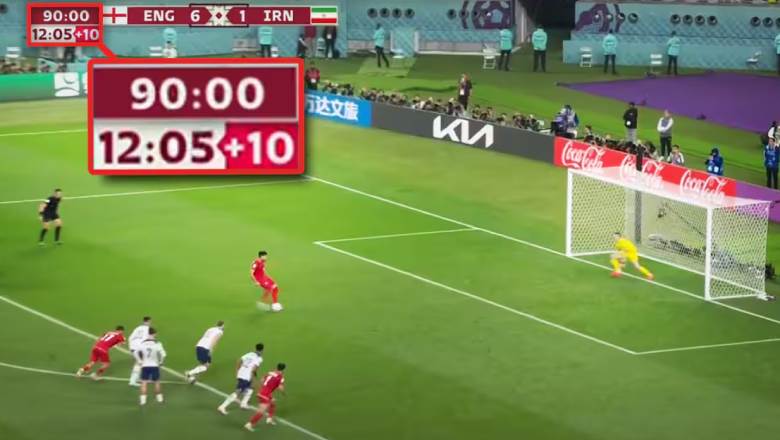
The match between England national football team and Iran national football team at the 2022 FIFA World Cup included nearly 30 minutes of total added time.
The first half alone featured more than 14 minutes after goalkeeper Alireza Beiranvand suffered a serious head injury that required lengthy treatment. The second half also contained multiple goals and VAR checks, resulting in another 13 minutes being added. The match eventually ended in the 117th minute despite not going into extra time.
3. Stockport County vs Doncaster Rovers (1946)
Although modern football often produces long matches because of injury time, one of the longest games in history took place in 1946 between Stockport County and Doncaster Rovers.
At that time, penalty shootouts did not exist. Matches were played under a “play until there is a winner” system. After 90 minutes of normal time and 30 minutes of extra time ended with the score tied at 2-2, the teams simply continued playing.
The match lasted for an incredible 3 hours and 23 minutes before it was finally stopped because darkness made it impossible for players and officials to see the ball clearly.
Goaloo Mobi has answered the question: How is injury time calculated? It has also reviewed the rules, historical changes, and several famous matches with unusually long added time in football history. To learn more about future football news, click on our link.
The Most Popular
-
 How many Premier League games are in a season? The complete breakdown
 -
 From Flames to Origami: Ranking the most iconic Japan football jerseys in history
 -
 Who is the captain of the Germany football team? Meet the leader of the Die Mannschaft
 -
 Is Pep Guardiola the best manager ever? The man who changed football forever
 -
 What team does Messi play for in 2025? Full details on his club and international career
 -
 Argentina national football team players 2026 World Cup list: Key stars and Predicted XI
 -
 Why did James Rodríguez leave Real Madrid? The rise and fall of a Galáctico dream
 -
 The €54 million catalyst: How much did Manchester United buy Bruno Fernandes?
 -
 The £75 million bargain: How much did Liverpool actually pay for Van Dijk?
 -
 Was he the best investment ever? How much did Real Madrid pay for Ronaldo?