
From Flames to Origami: Ranking the most iconic Japan football jerseys in history
The Japanese national team was founded in 1921 and belongs to the Japan Football Association. Historically, the country has participated in many international tournaments such as the Olympics and the Asian Games. However, it was not until the 1990s that Japanese football began to develop rapidly through systematic investment and professionalization.
Today, Japan is one of the strongest football nations in Asia, with a rich football culture and many iconic jersey designs. In this article, goaloomobi.com reviews the history of Japan football jerseys.
Japan football jersey history
Unlike many other countries that choose jersey colors based on their national flag, Japan adopted a much more unique color identity: blue.
1. The origin
When the Japanese national football team first began competing internationally, the team did not have a fixed jersey color. At the 1936 Olympics, Japan chose the traditional blue jersey worn by Tokyo Imperial University, which formed the core of the national team squad. During the tournament, Japan famously came from behind to defeat Sweden 3-2. The victory became so symbolic that blue gradually came to be regarded as a lucky color for Japanese football.
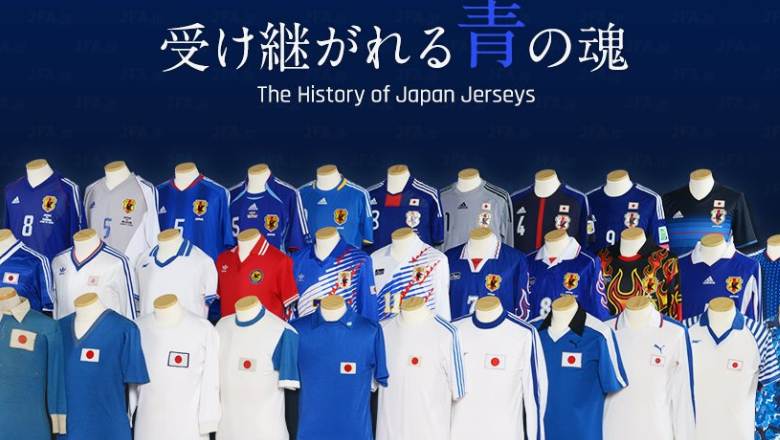
During the 1930s, Japan’s national team jerseys did not feature the national flag. Instead, they displayed the symbol of the three-legged raven Yatagarasu. The emblem was first introduced by the JFA in 1931 and was inspired by Japanese mythology, in which the raven guides the Emperor. The use of this spiritual symbol helped establish a unique football identity separate from political imagery.
2. The next stage
In the 1940s, Japanese football developed slowly because of the impact of World War II. By the 1950s, the national team returned with very minimalist jersey designs. The main color was a lighter shade of blue, while collars were usually round or ribbed. At that time, football shirts were considered more like official representative uniforms than commercial sportswear.
During the 1960s, Japan achieved its first major football success by winning the bronze medal at the 1968 Olympics. Around this period, the blue color became darker and more vibrant. White trim also began appearing on collars and sleeves to add visual contrast. At the 1964 Olympics, Japan wore a blue jersey with a white V-neck design that looked modern for its era.
The 1970s marked the beginning of sponsorship development. However, Japan still did not use one exclusive supplier and instead rotated between brands such as Adidas, Puma, and Asics. Jersey designs began featuring vertical and horizontal shoulder stripes, while materials gradually changed from heavy cotton to lighter synthetic fabrics.
3. Changes in the 1980s
In the late 1980s, under coach Kenzo Yokoyama, Japan experimented with switching to red jerseys to match the red sun on the national flag, known as the Hinomaru. However, this period coincided with disappointing performances, including failure to qualify for the 1990 World Cup. Many fans believed the red shirts did not bring good fortune, leading Japan to return to its traditional blue kits in 1992.
4. The end of the 20th century
In 1999, Adidas officially became the exclusive supplier of the Japanese national team, although the team had already been wearing Adidas kits since 1998. Ahead of the 2002 World Cup on home soil, Adidas introduced an extremely minimalist design. The jersey featured a clean blue color without heavy patterns or overlapping graphics. The main highlight was the red trim running from the collar down both sides of the shirt.
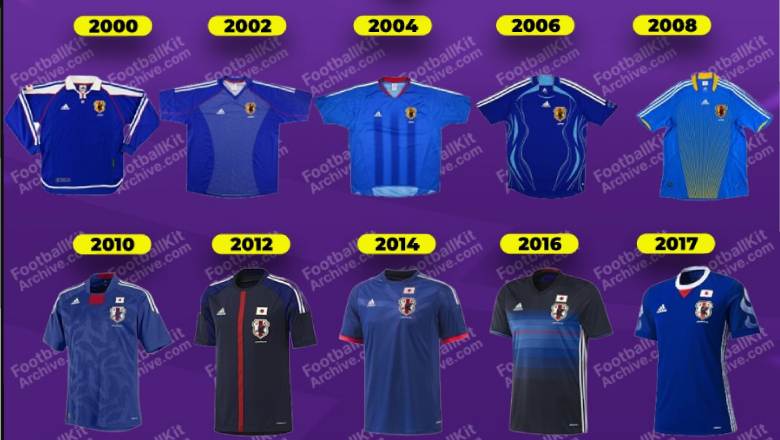
The 2002 kit also marked an important update to the team crest presentation. The Yatagarasu emblem was prominently placed on the left chest, with a small Japanese flag displayed above the JFA logo. While the home kit remained blue, the away jersey was white with blue and red accents on the shoulders and sides. Many fans still consider it one of the most beautiful away kits in Japan’s history.
5. From the 2002 World Cup to the present
At the 2006 World Cup, Adidas introduced light blue wave patterns across the jersey. These lines were inspired by reflections on a katana blade, symbolizing the courage and sharpness of Samurai warriors. This was also the first time the nickname “Samurai Blue” was heavily promoted worldwide.
For the 2010 World Cup, subtle feather patterns appeared across the chest, inspired by the wings of the Yatagarasu raven. The design symbolized protection and guidance. During the tournament in South Africa, Japan performed strongly and reached the Round of 16.
Four years later, at the 2014 World Cup, Adidas created a design featuring 11 subtle lines spreading from the JFA crest across the front of the jersey. These lines represented the 11 players on the pitch moving toward a common goal. When the players stood together before matches, the lines visually connected.
In 2018, Adidas unveiled one of the most celebrated designs in football history. The jersey featured countless tiny white dots across a dark blue background inspired by the Sashiko stitching technique used on traditional Samurai armor. The dark shade of blue was called Kachi-iro, meaning “the color of victory.” Many fans and collectors regard this as one of the greatest World Cup jerseys ever made.
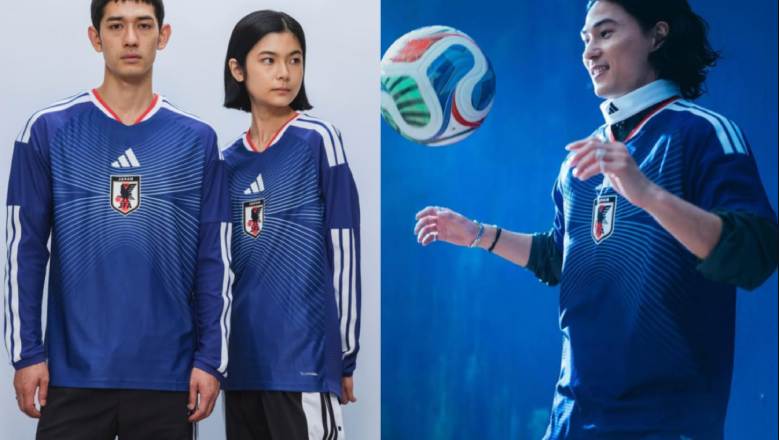
Finally, in 2022, Adidas introduced a jersey featuring interwoven blue and white polygon patterns with a subtle 3D effect. The design was inspired by the Japanese art of origami, with folded-paper motifs symbolizing hope, creativity, and the desire for breakthrough success.
Goaloo Mobi has just answered the question about Japan football jersey history, while also reviewing some of the most iconic designs in the history of the Japanese national team. To learn more about future football schedules, please click on the link to our page.
The Most Popular
-
 How many Premier League games are in a season? The complete breakdown
 -
 Who is the captain of the Germany football team? Meet the leader of the Die Mannschaft
 -
 Is Pep Guardiola the best manager ever? The man who changed football forever
 -
 How is injury time calculated? Why matches are getting longer than ever
 -
 What team does Messi play for in 2025? Full details on his club and international career
 -
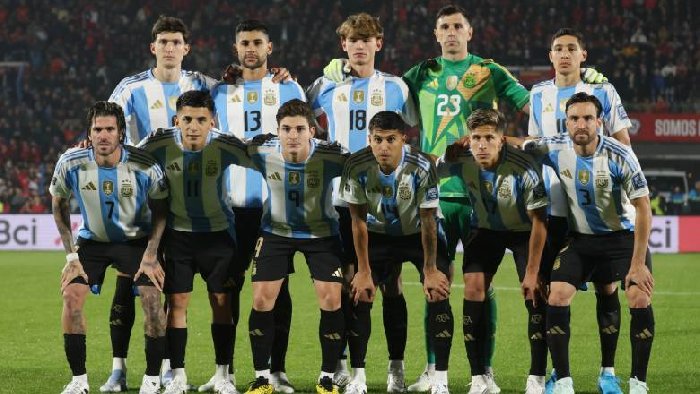 Argentina national football team players 2026 World Cup list: Key stars and Predicted XI
 -
 Why did James Rodríguez leave Real Madrid? The rise and fall of a Galáctico dream
 -
 The €54 million catalyst: How much did Manchester United buy Bruno Fernandes?
 -
 The £75 million bargain: How much did Liverpool actually pay for Van Dijk?
 -
 Was he the best investment ever? How much did Real Madrid pay for Ronaldo?