
What do referees spray on the field? How a simple tool ensures fair play during free kicks
Modern football increasingly relies on tools to help manage matches more smoothly. From advanced technologies like VAR and semi-automated offside systems to simple on-field aids, one of the most recognizable tools is the spray referees use during free kicks. This article from goaloomobi.com answers the question: What do referees spray on the field?
What do referees spray on the field?
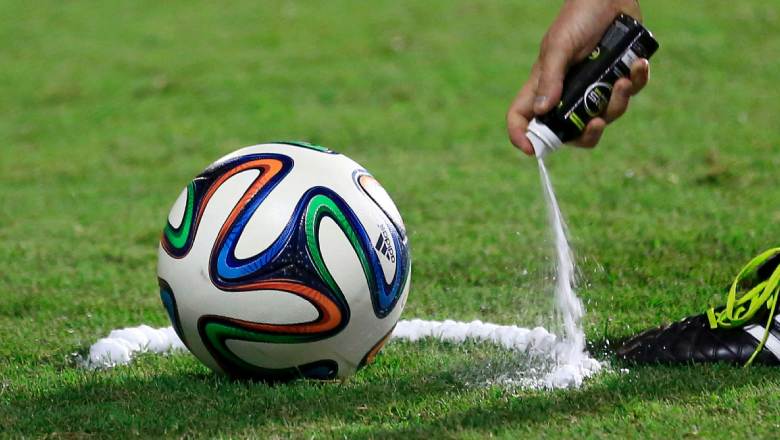
As the name suggests, it is called vanishing spray or self-dissolving foam. This tool helps referees maintain order during direct free kicks. Its primary purpose is to mark the position of the ball. The referee sprays a small circle around the ball to prevent attacking players from secretly moving it forward.
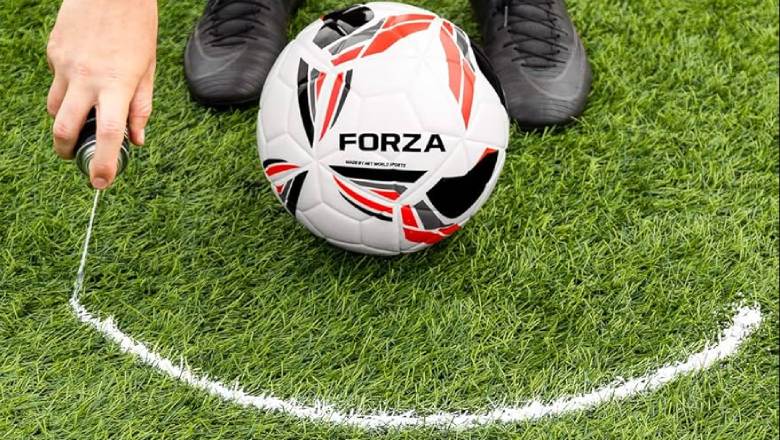
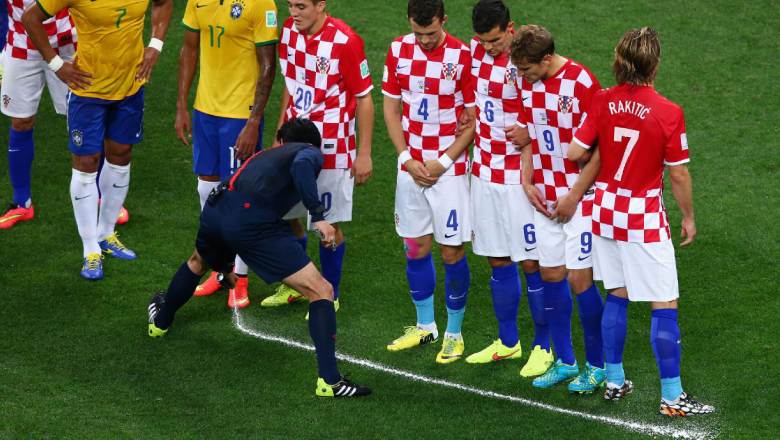
In addition, the spray is used to mark the defensive wall line. The referee draws a straight line 9.15 meters (10 yards) away from the ball. This is the minimum distance the defending players must keep when forming a wall. Having a visible line prevents players from gradually stepping forward to gain an unfair advantage.
Although it looks similar to shaving foam, the spray has a special chemical composition that allows it to disappear quickly. It typically contains about 80% water and around 17% butane gas, which expands to create foam. A small amount of surfactant stabilizes the bubbles, while vegetable oil helps the foam stick briefly to the grass before evaporating.
Why is this spray used in football?
Before the introduction of vanishing spray, defensive walls would often creep forward whenever the referee looked away or focused on positioning the ball. With a clearly marked line on the pitch, players have no excuse to step over it. If they do, the referee has clear justification to issue a yellow card.
The standard distance of 9.15 meters (10 yards) is designed to give the free-kick taker a fair chance to get the ball over the wall. Even moving forward by just one or two meters can significantly reduce the shooting angle. Therefore, the spray helps preserve the advantage for the attacking team.
It also reduces arguments. Referees no longer need to debate with players about whether the distance is correct, as the line provides clear visual evidence. Free kicks can be chaotic moments, so using spray allows referees to quickly restore order and keep the game flowing without unnecessary delays.
The history of the spray
The idea for vanishing spray originated in Argentina. Journalist Pablo Silva came up with the concept after witnessing a match where a defensive wall stood too close during a crucial free kick. However, the person who successfully developed and commercialized the product was Brazilian inventor Heine Allemagne.
Allemagne created a formula based on natural components to ensure it would not harm the grass or players’ skin. He named the product “Spuni.” The spray was first used in a professional competition during the Copa João Havelange in Brazil in 2000. It quickly gained popularity among referees and players for reducing disputes.
Following its success, Silva and Allemagne collaborated through the company 9.15 Fair Play Limit to improve the product. They refined the formula to make it more visible, faster to disappear, and suitable for different weather conditions.
Global adoption took time, but the turning point came at the 2014 FIFA World Cup, where the spray was widely introduced and became a major success. Since then, top competitions such as the Premier League, La Liga, and the UEFA Champions League have all adopted it.
However, its history also includes legal disputes. Heine Allemagne later sued FIFA, claiming unauthorized use of his invention without proper compensation. In 2021, a Brazilian court ruled in his favor, requiring FIFA to pay significant damages.
Incidents involving the spray
Despite its usefulness, there have been occasional incidents. Spray cans have sometimes malfunctioned, clogged, or accidentally sprayed referees or players due to pressure issues. In some humorous cases, referees have even sprayed directly onto a player’s foot when marking the correct position.
Although the spray is considered safe, some players, especially those with expensive boot sponsorships, dislike having foam sprayed on their shoes. While it does not cause lasting damage, the temporary residue can slightly affect grip on the ball for a short time if applied heavily.
Goaloo Mobi has answered the question: What do referees spray on the field? To learn more about the latest football schedules, please click on the link to our page.
The Most Popular
-
 How many Premier League games are in a season? The complete breakdown
 -
 From Flames to Origami: Ranking the most iconic Japan football jerseys in history
 -
 Who is the captain of the Germany football team? Meet the leader of the Die Mannschaft
 -
 Is Pep Guardiola the best manager ever? The man who changed football forever
 -
 How is injury time calculated? Why matches are getting longer than ever
 -
 What team does Messi play for in 2025? Full details on his club and international career
 -
 Argentina national football team players 2026 World Cup list: Key stars and Predicted XI
 -
 Why did James Rodríguez leave Real Madrid? The rise and fall of a Galáctico dream
 -
 The €54 million catalyst: How much did Manchester United buy Bruno Fernandes?
 -
 The £75 million bargain: How much did Liverpool actually pay for Van Dijk?